Coho Return Higher than Expected

Coho survey found this carcass in French Creek on 12-11-11. Round lesions are from lampreys that had latched onto fish during upstream migration, a natural and common occurrence.

Coho survey found this carcass in French Creek on 12-11-11. Round lesions are from lampreys that had latched onto fish during upstream migration, a natural and common occurrence.

The following press release was sent out by the Scott River Water Trust on 12-15-11. Articles were published in the Eureka Times-Standard on 12-21, the Siskiyou Daily News on 12-23, the Redding Record-Searchlight on 12-25, and the Capital Press on 12-29.

Coho Salmon Returns Much Higher than Expected

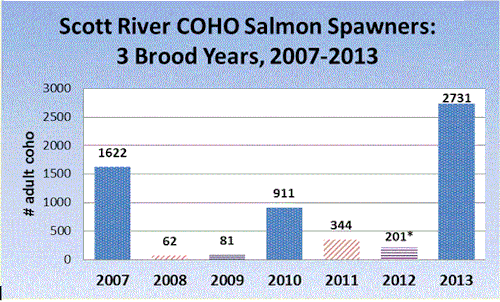
ETNA, California. This season’s surprisingly higher return of coho salmon to the Scott River is generating lots of local excitement. At least 340 adult coho are documented, aof December 8, at the Scott River weir. This number represents a significant increase over the 62 fish counted when this brood year last returned 3 years ago in 2008.

“The California Department of Fish and Game is encouraged by the preliminary 2011 adult coho returns to the Scott River, indicating an increase in adult coho salmon abundance,” commented Morgan
Knechtle, an associate fisheries biologist with CDFG in Yreka. Knechtle operates the department’s video weir where the fish data are collected, located 18 miles upstream from the mouth of the river.

Habitat restoration efforts are one of the reasons for the better numbers, says Gary Black, contractor and former senior project manager with the Siskiyou Resource Conservation District (RCD). “The Scott Valley community should be proud of the unexpectedly higher coho return because measures taken by its residents have helped the stream habitat in the Scott River and tributaries to become much better than it was 10-15 years ago. The facts tell us the Scott River is a good and improving stream for fisheries.”

Ocean conditions also play a role in salmon population cycles. Coho salmon tend to return in three-year cycles, hence the comparison between the 2008 and 2011 runs. Biologists had predicted a much lower return of about 37 fish for this low brood year, based on the average past survival rate of yearling coho leaving the Scott River and returning as adults. The Scott River has one stronger brood year and two weaker ones. The stronger brood year was in 2010 with 927 coho returning and again in 2007 when 1,622 returned.

The annual survey of coho spawning grounds in the mainstem Scott River and tributaries is also ongoing to identify where the redds (nests) and carcasses are found. In Scott Valley, the Siskiyou RCD

staff is leading the survey where access is available, while CDFG is coordinating the effort in the canyon area. [See attached photo.] This information will help the Scott River Water Trust identify where the young coho salmon may need additional water next summer to ensure better survival. As a win-win tool for fish and farmers, the Water Trust will pay for water to be left instream. An estimated 2,174 yearlings migrated out of the river for this brood year in the spring of 2010, representing 34.5 yearlings produced per adult, according to Fish and Game data. This freshwater survival rate appears to be an indicator of in-river conditions. In contrast, the out-of-basin survival rate may indicate downriver and ocean conditions. Until this year,that rate had averaged 1.74 percent yearlings to survive as returning adults.

Coho salmon in the Klamath River Basin were listed as a threatened species in 1997 under the federal Endangered Species Act (ESA) and in 2005 under the California ESA. Before and after those listings, the Scott Valley community has actively participated in voluntary watershed and stream restoration efforts. More restrictive regulatory programs by state and federal agencies were also proposed. Expectations are for increased population trends of all three coho brood years.

Caption: “Coho salmon carcass found during survey in French Creek on Dec. 11th. Round lesions are from lampreys that had latched onto the fish during its upstream migration, a natural and common occurrence.

2011 Water Lease Season Summary

A wetter than normal water year in 2011 helped increase streamflows in Scott Valley and also reduced the need for water leasing by the Water Trust. Summer habitat was benefitted by the addition of 181 acre-feet of water through three leases in French Creek and Patterson Creek. Added flows ranged from 0.2 to 5.0 cubic feet per second (cfs). Intensive habitat monitoring was performed by Siskiyou Resource Conservation District (RCD) staff at the Patterson Creek lease site using draft protocols developed by the National Fish and Wildlife Foundation (NFWF).

A very dry fall has started off the 2012 water year, which began October 1. While the Scott River did not dry up this summer and had adequate fall flows for fish passage, an experimental effort was made to lease water from October 15 to November 28. An addition of 8 cfs, the majority of the stockwater right for an irrigation district and adjacent landowner, was made at river mile 47 at Young’s Dam. The physical habitat effects of the leased 720 acre-feet were also measured by the RCD staff, again using NFWF draft protocols.

Salmon surveys are showing an above average return of adult Chinook and coho salmon to the Scott River. Both species were able to reach good spawning habitat in the upper Scott River above Young’s Dam. From preliminary 2011 data collected by the California Dept. of Fish and Game at their video weir below Scott Valley, the number of Chinook adults entering the valley is estimated at 4,350 fish while 352 coho spawners have also arrived to date. Complete counts will also include figures from the lower Scott River and tributaries.

See the following article on the significance of the coho.

Talk Before Legislative Joint Fisheries Committee Aug. 16th

Our Executive Director, Dr. Sari Sommarstrom, recently gave a panel talk in Sacramento at a Legislative information hearing on the topic, “Coho Salmon on the Brink: Understanding the Depth of the Crisis and Recovery Strategies.” The hearing was sponsored by the Joint Committee on Fisheries and Aquaculture: http://asmdc.org/members/a01 Sari’s powerpoint can be found on this Water Trust webpage. Below is the Summary which was presented as a handout:

FACTS

The Scott River still supports a natural run of coho salmon, often one of the best in CA.

  • The 2010 adult coho run size was 927 fish (via video weir counts by CDFG), which is the good brood year. Historic estimates before 1965 were 800 to 2,000 coho.
  • Two weak brood years (’08 and ’09) produced less than 100 adults.
  • The Scott’s run appears to be much larger than other natural coho runs in CA in one out of three years (2007 and 2010).
  • Less than a decade of good data does not allow trend analysis or prediction.

The Scott River Water Trust became the first water trust in California in 2007 as a win/win tool.

  • Water leases are a useful voluntary tool to help immediate flow needs in coho streams.
  • Criteria for choosing streams for additional flows target potential coho rearing habitat using long-term data, field experience, and project monitoring.
  • Scott River coho restoration checklist shows significant progress in almost all areas.

The SWRCB’s Division of Water Right’s instream process under Water Code 1707 is too cumbersome and expensive to make voluntary instream dedications worthwhile.

  • It took the Water Trust two years and $30,000 just to add “instream” as a beneficial use to one water right.
  • The uncertain process lumps small water transfers in streams where coho reside with large water transfers, such as through the Bay-Delta.

Beaver ponds provide excellent coho habitat and water storage for free yet are not supported by CDFG policy.

  • CDFG’s hunting regulations and depredation policy encourage removal of beaver.
  • State Coho Recovery Strategy does not actively support beaver pond restoration.

RECOMMENDATIONS

  • Promote systematic, annual coho population data for representative coho streams.
    • Data needed on adult spawners, redd locations, downstream migrants, rearing sites.
    • Sustain current data collection and reporting efforts by CDFG on the Scott River.
    • CDFG should determine freshwater and marine survival rates for each brood year in each major coho stream in the State.
  • Let good data and analysis lead us to our conclusions and actions. Ask for evidence when assertions are made about cause and effect related to coho.
  • Support ways to improve the SWRCB’s water rights process for instream transfers in coho streams.
    • Ask SWRCB to develop a separate process for small instream transfers within watersheds having threatened salmonid populations.
    • Provide for a Categorical Exemption under CEQA for small instream transfers.
  • CDFG needs to have a beaver management policy that is coho-friendly yet reasonable when conflicts arise.

Scott River Water Trust and Dry Pools

The Scott River Water Trust was surprised by a recent press release by Klamath Riverkeeper that fish were dying in Patterson Creek supposedly as a result of water diversions. As of July 7th, all of the water diversions on Patterson Creek above Highway 3 were leased to stay instream for the benefit of rearing habitat for young coho salmon and steelhead. Good habitat exists about ¼ mile above the bridge for several mile upstream. Of the 927 adult coho that returned to the Scott River last winter, a significant number were seen spawning in Patterson Creek, as the species also did in 2007.

For some reason, Klamath Riverkeeper seems to believe that all drying streambeds and stranded pools with fish in Scott Valley are caused by stream diversions. Without such human water use, they claim, the creeks would never be “dewatered”.

No one likes to see dying fish in stranded pools but one can’t fight natural conditions either. No one should be surprised that some sections of streams dry up every year in Scott Valley. While water diversions can contribute to this situation, this behavior in these stream reaches mentioned by Klamath Riverkeeper’s press release is fundamentally a natural condition and documented historically.

In 1851, journal entries by George Gibbs observed that the river in Scott Valley has only “two or three small branches which continue to flow during the dry season.” He also noted the western side of the valley next to the mountains as being very gravelly and “cut up with arroyas from the mountains”.  Around 1854, the pioneer that Kidder Creek is named after found, to his dismay, that the creek’s flow began falling in July every year and did not begin flowing again until the rains began.

An “arroyo” is a Spanish term for an intermittently dry creek. That is what we have in the lower reaches of most of the tributaries to the Scott River, especially when steep mountain streams enter the flatter alluvium of Scott Valley. Blame the geology and the climate. These “alluvial fans” can be readily seen where State Highway 3 bridges Kidder Creek, Patterson Creek, and Etna Creek. There is not enough stream energy to continue carrying the larger rocks. The full natural flow would not be sufficient to sustain surface flows, as shown by historic evidence.

The Water Trust seeks water leases from active diverters in priority coho streams where additional flows can benefit summer rearing habitat. French Creek and Shackleford Creek have sufficient flow during this wet year so the Water Trust is not seeking water leases there, as it has during past drought years. The main stem Scott River is currently at 200 cubic feet per second (cfs) flow. With the lowest flow always around September 1st, there is no danger of the river drying up in the next 3 weeks.

The Water Trust was glad to see that this year’s stronger coho brood year had a run of 927 adults, which is in the ballpark of the 800 to 2,000 coho that the California Dept. of Fish and Game (CDFG) estimated the Scott River’s population to be in the early 1960s.

2010 Salmon Final Counts for the Scott — 927 Coho

Final data on the Scott’s 2010 salmon populations  are at last available from Cal Fish & Game. The estimated total for 2010 is 2,508 Chinook salmon and 927 coho salmon.

Much of the data comes from CDFG’s Fish Counting Facility, which is a weir located 18 miles upstream from the mouth of the Scott River and attached with a 24-hour recording video camera. Field surveys of redds, carcasses and live fish throughout the river and tributaries help complete the tally. 

The Chinook population is higher than last year but lower than 2008’s. The coho population is much higher than in 2009 with 81 adults and in 2008 with 62 fish, both years known to be weaker brood years. This year is the coho’s stronger brood year (of its 3 brood years), as was 2007 when 1,622 adults were counted at the weir.

Stream flow was not an access problem in the mainstem Scott during the October-November period of the Chinook run nor during the November-January coho run in the tributaries. High flows on a total of about 13 days caused the video filming to be stopped so estimates had to be made for the coho numbers during those periods. The Chinook run appeared to end about Dec. 1st while the last coho was seen on Dec. 24th.

Contact Morgan Knechtle at CDFG in Yreka  at (530) 842-3109 for more details on the 2010 salmon returns.

881 Estimated Coho Spawners for Scott River in 2010

A preliminary estimate of 881 coho salmon adults passed the California Dept. of Fish and Game’s video measuring weir at mile 18 of the Scott River during the 2010 spawning season from November to January. This figure is up considerably from 81 adults counted last year and 62 adults in 2008, but lower than 2007’s count of 1,622 adults. The Scott River is known for having one brood year much stronger than the other two brood years in the 3-year life cycle of its coho, based on CDFG data going back to the early 1990’s. Compared to other California streams supporting natural coho runs, the Scott River is one of the highest producers of coho spawners each year but all numbers are depressed.

Adult coho salmon (photo by CDFG)

Adult coho salmon (photo by CDFG)

Field surveys by the Siskiyou RCD biologist and crews helped track the location of coho spawner carcasses and redds in Scott Valley’s tributaries, where coho prefer to spawn. Based on this field data, the Water Trust will be targeting priority streams and key reaches where the juvenile coho will likely rear this summer. Depending on the Water Year Type and anticipated flow conditions, lease prices will be set by the Water Committee and potential water lease sites will be sought.

Instream Use Added via Water Code 1707 to French Creek Water Right

“Instream use” has become a new legal option for one water user on French Creek! This use was recently approved by the State Division of Water Rights to be added to a water right at the request of the Scott River Water Trust and the water right holder, John Spencer. As a result, the water user has an instream option when he and the Water Trust agree on a lease that will not risk forfeiture of his pre-1914 appropriative water right, if used instream for 5 or more years. Original uses were limited to irrigation, stockwatering, and domestic. The change also allows the Watermaster to shepherd the instream leased water past downstream water users of the French Creek Decree.

French Creek - lower

French Creek - lower

This  instream process under Water Code section 1707 officially began on Feb. 4, 2009 with the submittal of a petition to the State Water Resources Control Board, Division of Water Rights. The petition requested to change the purpose of use under the water right by adding preservation and enhancement of fish and wildlife resources and to change the place of use to include the reach of French Creek from the point of diversion to the confluence with Scott River. An Order was issued by the Division on Feb. 25, 2010.  However, the Trust believed that several issues needed clarification so it decided to submit a Motion for Reconsideration. Amended Order WR 2011-0001-Exec, issued Jan. 24, 2011, was the result. The Trust believes that almost all of its issues were resolved with this new Order.

The final step in the instream dedication process will be to file a formal motion with the Siskiyou County Superior Court, which retained continuing jurisdiction over the Decree, to obtain a supplement to the Decree adding “instream” as an additional use to this particular water right. Stay tuned for a later update.

The Bella Vista Foundation generously funded this effort to demonstrate the 1707 process for adding instream use to a water right. Legal services were capably provided by Rob Donlan of Ellison, Schneider & Harris in Sacramento.

Other 1707 instream dedications in Scott Valley are pending on Sugar Creek and East Fork Scott River, brought by the Siskiyou Resource Conservation District after water conservation projects provided saved water.

No Fall Leases Needed in 2010

Unlike the past three years of drought, the Scott River’s flow in early October was sufficient to provide upstream access for Chinook salmon spawners without adding leased water. From Oct. 1 through Oct. 23, the USGS gage at river mile 21 fluctuated around 50 cubic feet per second (cfs), more than adequate to allow spawning salmon to move up through the boulders in the Scott River canyon and up into Scott Valley, where the majority of spawning gravels are located. A storm on Oct. 24th brought flows up past 1,000 cfs and average flow has exceeded 200 cfs almost every day since that storm. Chinook salmon reports by California Dept. of Fish and Game indicated that spawners were moving upstream in the Scott starting Sept. 30th and were not impeded by flows.

As pulse flows appear to attract coho salmon to move upstream during their November and December migration period, the potential for leases was still present if the river maintained a ”flat line” flow pattern. Fortunately, the pattern of storms and runoff created a series of natural pulses. Coho salmon spawners were first noted at CDFG’s Scott River video weir at river mile 18 around Oct. 26th and upstream passage has apparently not been affected by flows.

Summer leases benefitted 3.7 miles of stream habitat in 2010

The 2010 Summer Water Lease Season ended with 314.5 acre-feet added to French Creek and its Miner’s Creek tributary. Five diversions released water ranging from 0.25 to 0.76 cfs, with each lease lasting from 37 to 74 days. The earliest lease began July 19th and the latest one began Aug. 29th, all ending on Oct. 1st. With several adjacent diversions, the instream benefit for fish habitat amounted to 19,650 feet or 3.7 miles. French Creek supports populations of coho salmon, steelhead, and Chinook salmon during the summer rearing period.

No leases were obtained in Shackleford Creek this year, but the base flow was much better this year than previous years.

A cool, wet spring and summer helped keep streams flowing better this season than the past three seasons. More water was available to lease yet less was needed to maintain cool flows and pools.

2010 Summer Water Leases Begin in French Creek

French Creek is receiving an added 2.3 cubic feet per second (cfs) of streamflow this week, thanks to 5 new  voluntary leases signed by water users with the Water Trust. An initial lease began on July 19th for 0.76 cfs on lower French Creek, where young steelhead, coho salmon and Chinook salmon like to congregate and grow during the productive summer period. On July 29th, three more water diversions upstream were either turned off or reduced in amount to provide 1.21 cfs below Miner’s Creek. An adjacent diversion also released 0.3 cfs in upper Miner’s Creek on August 3rd. These leases will continue until October 1.